The authors offer eight policy recommendations, and propose a roadmap for fostering oil trilateralism, greater South–South cooperation and sustainable development in the South Atlantic region.
The author examines the prospects for the rapid recovery of Iran’s defensive capabilities, and concludes that its missile programme will remain at the centre of the country’s efforts.
The authors argue that there is a link between key technological and operational characteristics embodied by UAV systems, and the expansion, population and contestation of the air littoral.
The author explores the export potential of the J-35A, evaluates its competitiveness against current and future rivals, and examines key obstacles that could limit its success internationally.
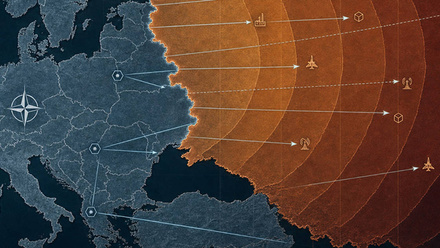
The authors examine NATO’s open source intelligence doctrine and analyse its role within the joint intelligence, surveillance and reconnaissance process.
The author introduces the collateral deception framework which adapts Ross Bellaby’s Ladder of Escalation to situate the different methods of deception.
The foundations of the international architecture of the post-Second World War world were laid in the final months of the conflict. Gill Bennett reflects on some of the structural weaknesses and cracks we can clearly see today that lay hidden in those foundations from the start.
In this issue's special section on the 80th anniversary of the end of the Second World War, we decide to mark it with a few reflections on the legacy of the war and to ask what may endure and what may have had its time.
The authors suggest that a cyber-electromagnetic activities framework might offer a valid tactical solution for electromagnetic operations, facilitating the synchronisation of both kinetic and non-kinetic effects.