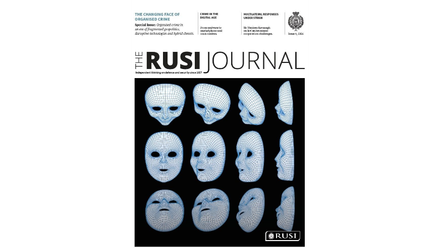
Editorial
If we are cursed to live in interesting times, then the events of the last few months must be the Fates’ way of testing us. There is certainly plenty to keep an editor in work, with no shortage of new articles being submitted to the RUSI Journal. In fact, the weekly total has doubled since the turn of the year. That means two things. First, we can be ever-more discerning in what we publish while maintaining quality and breadth of output. Second, we can also increase the output. You will see from this issue and the next (which is already well on the road to production) that we are packed with brilliant articles – far more than we used to have. I aim to continue this trend for as long as we can – hopefully, indefinitely. It is good for members, readers and, of course, our contributing authors.
We are looking to amend the RUSI offer slightly in another way, too. By the time you read this you may have noticed some changes to the RUSI Newsbrief. If you haven’t, then please take a look. One of the benefits of an academic journal is knowing that the content has been seriously considered, researched, reviewed and edited. The corresponding downside, however, is the time it takes from writing and submitting to being published online or in print. It means that many of our more topical papers focusing on current events may seem dated by the time they are published. And so, we are now trialling the use of Newsbrief for what are effectively pre-prints of Journal articles. Pre-prints are early versions of academic research made available before any major peer review or deep editing has taken place. There will be an inherent risk in doing this – something may be wrong or poorly worded, but we believe the benefit of providing early access to emerging work on contemporary topics is worth it. Articles that prove their value will appear formally in the Journal later. Others may not progress that far. The result should be a neat hierarchical progression from the opinion pieces of RUSI Commentaries to emerging research in Newsbrief to top quality research and analysis in the Journal. I am excited by it.
I am excited by this issue – this special issue – too. As guest editor Cathy Haenlein writes overleaf, we are turning to a topic not often considered in the pages of mainstream defence and security journals, despite being of incredible consequence to national and international security. I will not repeat what you are about to read, except to say that some of the articles we have commissioned from those at the forefront of organised crime research and law enforcement have really broadened my mind. I am sure you will feel the same, and you may even pause for thought the next time you receive a scam phone call or a phishing email, or are offered legal goods at prices that are too good to be true.
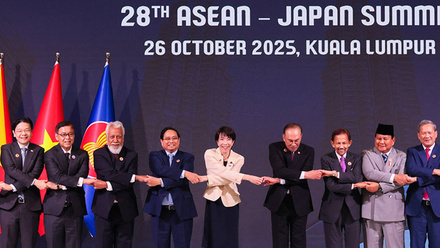
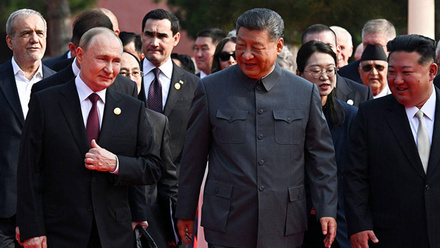
There are three ‘regular’ research articles in this Journal, too. Returning to my opening sentence, if we are cursed to live in interesting times then we had better do our best to understand them. Our articles by Alexandre Brans, Alex Kaplan and Roderick Parkes, and David Roberts attempt to unpick how the global (dis)order is shifting. Please enjoy, and join the debates.
Kevin Rowlands, Editor of the RUSI Journal
Guest Editor Foreword
The Changing Face of Organised Crime: An Introduction
Twenty-five years after the adoption of the UN Convention against Transnational Organized Crime (UNTOC), the global illicit landscape looks markedly different from that confronted at the turn of the millennium. Profound changes in technology, geopolitics and international security have reshaped organised crime and the environments in which it operates. Yet many conceptual frameworks remain rooted in assumptions formed in a very different international moment.
This special issue of the RUSI Journal responds to the widening gap between inherited frameworks and contemporary realities. It brings together leading researchers and practitioners to examine how organised crime is evolving, how states are responding, and whether existing approaches remain fit for purpose in 2026 and beyond.
The timing is significant. The geopolitical conditions that enabled the near-universal adoption of the UNTOC in 2000 have receded, replaced by a more fragmented international order in which cooperation on transnational threats is harder to sustain. Meanwhile, organised crime has become more adaptive, technologically enabled and politically entwined. Criminal actors now operate across blurred boundaries between licit and illicit economies, physical and digital spaces, and state and non-state spheres of influence. In this context, organised crime intersects ever-more closely with questions of national security, governance, strategic competition and international stability.
Authors were selected not because they advance a single interpretation of the issue, but because they bring expertise in different aspects of the threat landscape, exposing the limits of prevailing assumptions. Together, their contributions demonstrate the difficulty of categorising organised crime through traditional policy and enforcement models.
The issue opens by examining how criminal networks exploit globalisation and shifting demand. Angela Me and Paolo Campana assess how far research and policy have kept pace, showing criminal networks to behave with the adaptability of actors in the legal economy, expanding into rapidly evolving market spaces. In her photo essay, Anna Sergi shadows a member of the modern ’ndrangheta, demonstrating how historically rooted criminal organisations have exploited global markets while retaining distinctive forms of social power. Alexander Kupatadze exposes a gap between perception and reality, whereby focus remains on illegal commodities such as drugs and firearms despite the expansion of lower-risk illicit trade embedded in legitimate markets.
The second section turns to international frameworks under strain. Mark Shaw and Ian Tennant trace the evolution of the multilateral response to organised crime and consider lessons for the future UN approach to transnational criminal threats. Sir Stephen Kavanagh offers a practitioner perspective on the limits of international law-enforcement cooperation in a poly-criminal age.
The issue then situates these dynamics in wider geopolitical context. Magda Long explores organised crime as a structural force in contemporary geopolitics, drawing on Russia, China, the Western Balkans and Spain to show how criminal actors perform system-level functions. Heather Marquette and Matthew Redhead outline how states outsource covert tasks to criminal networks, highlighting the political economy sustaining these relationships and proposing cross-government cells to better integrate responses. Matt Ince and I consider implications for the UK intelligence community, arguing that organised crime has been underweighted as a strategic intelligence priority and calling for a reframing of the issue.
A further section explores crime in the digital age. Will Lyne, Jamie MacColl and Jason R C Nurse examine the convergence of criminal and state cyber activity, and the implications for national security. Federico Varese analyses scam factories and emerging forms of polycriminality within cybercrime ecosystems. Mina Chiang’s field observations show how scam compounds combine technological enablement with coercion and transnational organisation.
The final section deals with governance and control. Robert Muggah explores the politics of criminal governance in Latin America and the Caribbean, while Atta Barkindo examines the convergence of ideology, technology and crime in the Lake Chad region. Zora Hauser concludes by analysing the challenge facing European democracies, warning that misunderstanding the threat can carry profound consequences.
While this special issue seeks to advance understanding of organised crime’s evolving character, many questions remain unresolved. Technological transformation, uneven data and shifting geopolitics mean that several trends remain only partially understood. Future analysis must grapple further with issues such as shifting state– crime entanglements and ‘grey-zone’ governance, emerging illicit markets and the diversification of digital criminal economies within a forward-looking research agenda.
This collection seeks to contribute to both academic debate and policy and operational thinking. By bringing together diverse perspectives, it encourages renewed reflection on the frameworks shaping contemporary responses to transnational illicit activity. At a moment when organised crime is becoming more adaptive and hybrid, developing clearer ways of understanding the threat is an increasingly urgent task.
Cathy Haenlein is Guest Editor and Director of Organised Crime and Policing Studies, RUSI
Evolving Illicit Economies



Multilateral Responses Under Strain
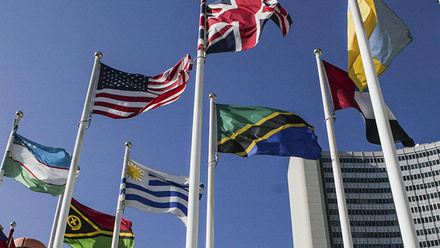

Organised Crime, Statecraft and Geopolitics



Crime in a Digital Age



Criminal Governance, Democracy and Control
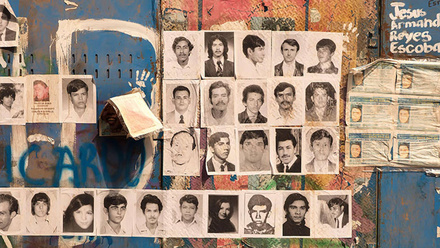

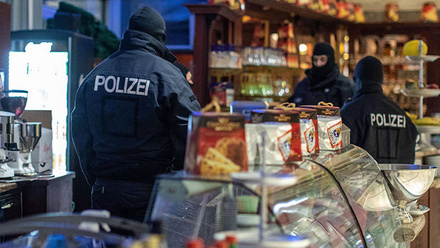
International System Realignment

Regulars
Members only


Members only
Members only
Members only

Members only