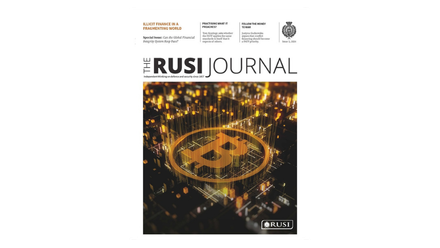
Cover image: Courtesy of KanawatTH/Adobe Stock
Editorial
Since my last editorial, the UK’s defence and security landscape has shifted again. The reason for the change is not just Russia’s ongoing war against Ukraine, or the on–off war in the Middle East, but a different uncomfortable truth: security comes at a cost. The resignation of the UK Defence Secretary, the publication of the Defence Investment Plan and the outcomes of the NATO Summit in Ankara have all reinforced the centrality of financial commitments to achieve credible defence. Across the Alliance, debates have been about levels of spending, capability investment and the sustainability of deterrence. Most Allies are stepping up, but the message is clear – security cannot be delivered on the cheap.
And then we have a change of prime minister and, along with it, all the stock-taking and reprioritisation that that entails.
However, this is only one side of the coin. As all Western states tackle the rising cost of defence, those who seek to do us harm face financial constraints of their own. Malign actors, whether they be states, state proxies, terrorist organisations or transnational crime networks, still depend on access to, and movement of, money if they are to operate effectively. Their capacity to recruit, equip, sustain and project influence is tied to financial flows that are often opaque but, sadly, deeply embedded within the global economy.
This dichotomy between the cost of defence and the vulnerabilities of adversaries’ finances sits at the heart of this RUSI Journal special issue. Illicit finance should not be seen as a peripheral concern in our profession; it is absolutely central and needs as much attention as new bits of kit for armies, navies and air forces. Efforts to detect, disrupt, deter and destroy rogue financial networks offer a way of constraining our adversaries without necessarily resorting to kinetic violence.
As the Guest Editor’s introduction explains, the contributions in this Journal issue explore how illicit financial systems operate, how they intersect with legitimate economic structures and how they can be countered. They also point to opportunities for improved coordination and regulation which could deliver disproportionate strategic effects.
If investment in defence is the visible commitment of states to their own security, then measures to counter illicit finance represent a less visible, but equally vital, effort to erode the capabilities of those who threaten us. Bringing these two perspectives together is essential. Defence and security is not only about how much we spend, but also about how effectively we can constrain adversaries’ resources.
I am also thrilled that, in another new departure for us, we are featuring the artwork of an external art director and designer. Abigail Rogers has a background in publishing and editorial design and has previously held positions at the Sunday Times and Times Higher Education, and now works freelance for clients including the Financial Times, Esquire and New Balance. She creates thoughtful visual communication across print and digital media and, I am sure readers will agree, has brought impact and coherence to this special issue’s articles.
This issue of the RUSI Journal is not constrained to one topic, however. In its pages, you will find some fascinating articles on the changing battlefield and on geographical pressure points. Jorge Rivero discusses the proliferation of drone technology and the spill over from Ukraine, while Nick Reynolds argues for the value of an older tactic – sniping. They should be read together to achieve a fuller appreciation of the dilemmas facing planners and soldiers. Manish Tayal then takes us back to the Strait of Hormuz with a novel analysis of India’s approach to variable geometry in a post-rules-based order. Finally, in an extension to our High North themed issue from earlier in the year, our photojournalist Susan Schulman visits Barentsburg, the Russian settlement on Norwegian Svalbard, and discovers a place between two worlds.
In all, there is something for everyone in this issue. Enjoy.
Kevin Rowlands, Editor of the RUSI Journal
Guest Editor Foreword
Illicit Finance in a Fragmenting World: An Introduction
The global system for combatting illicit finance was built on the foundations of the post-Bretton Woods order and came to be centred around the Financial Action Task Force (FATF), established in 1989 during the G7 Summit in Paris. It emerged in an era defined by growing economic integration, multilateral cooperation and a global financial architecture built on the dominance of the US dollar.
Today, that system operates in a different environment, one characterised by geopolitical rivalry, sanctions proliferation, technological innovations and the fragmentation of the global financial order. Rather than witnessing the emergence of a coherent alternative system, we are seeing a growing diversification of financial infrastructure, driven by various state and non-state actors motivated by the pursuit of strategic autonomy, necessity or new opportunities.
This matters because the assumptions underpinning the global anti-financial crime architecture no longer hold as firmly as they once did. The world is becoming less cooperative, more contested and increasingly fragmented. At the same time, finance plays a dual role: on the one hand, it enables a widening range of threats, from war financing and hybrid threats to political interference and sanctions evasion; on the other, it increasingly serves as a critical tool for detecting and disrupting these activities, as explored in this issue by Justyna Gudzowska, Daryna Dvornichenko, Olivia Allison, Oksana Ihnatenko and Richard Sanders.
And yet, much of the global response remains rooted in frameworks designed for a different era.
This special issue asks a simple but increasingly important question: is the current system for governing illicit finance still fit for purpose, and if not, how should it evolve?
The contributions in this issue approach that question from different angles, but several common themes emerge. One is the growing tension between technical compliance and real-world effectiveness, explored by Mariano Federici, Tri Andriyanto and David Lewis. Another is legitimacy: who sets the rules, who bears the costs of compliance and whether those costs are distributed fairly, are questions examined by Juliet Ibekaku-Nwagwu and Jacqueline Borja. Finally, Tom Keatinge, the Founder and Director of the Centre for Finance and Security at RUSI, established 12 years ago as the first global research programme focused specifically on the intersection of finance and security, asks a fundamental question: is the FATF itself truly practising what it preaches?
A particularly important objective of this issue was to create space for voices too often underrepresented in global policy debates. We intentionally invited contributors from the Global South, including Yona Wanjala, Jacqueline Borja, Juliet Ibekaku-Nwagwu and Mariano Federici, to help address this imbalance and bring perspectives often missing from discussions shaping the global financial integrity agenda. As Elisa de Anda Madrazo reflects in her conversation with Tom Keatinge, one of the key lessons from her presidency of FATF is that the legitimacy and effectiveness of global standard-setting increasingly depend on the willingness to stay humble, listen and learn from voices beyond the traditional centres of influence.
This matters because many jurisdictions in the Global South operate on the frontline of the fight against corruption, kleptocracy and illicit financial flows. They face some of the greatest exposure to the harms caused by illicit finance, while also bearing significant compliance burdens imposed by the global system. Detecting and disrupting kleptocratic networks increasingly requires approaches that better reflect these realities.
This special issue was made possible thanks to the support of the National Endowment for Democracy (NED), whose longstanding support for the Centre for Finance and Security at RUSI has helped bridge grassroots expertise from the Global South with policymakers shaping the global anti-financial crime architecture.
This collection does not seek to offer a single answer. Instead, it aims to provoke debate, challenge assumptions and broaden the conversation. We hope the ideas presented here, and the voices captured in these pages, will contribute meaningfully to the future of global financial crime governance and, most importantly, be heard.
Dr Kinga Redlowska
Guest Editor and Head of the Centre for Finance and Security at RUSI Europe
Global Governance



Russia and Ukraine


Africa

The Indo-Pacific

The Changing Battlefield


Pressure Points

Members only